
Professional tree pruning services

Bring the light back into your garden! If your trees need professional pruning or shaping, trust Alexander Carson Tree & Garden Services of Stockton-on-Tees. Call today for a prompt, reliable service that keeps your trees healthy and looking their best.

Get in touch

Restore Light and Health to Your Overgrown Trees

Overgrown or out-of-shape trees can quickly compromise the beauty and safety of your garden. At Alexander Carson Tree & Garden Services, we offer professional tree pruning, thinning, and crown reductions across Stockton-on-Tees and the wider Teesside area. Contact us today for a prompt, reliable service that brings the light back into your garden.

Pruning General
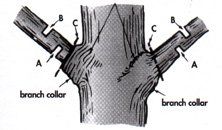
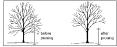
Each tree is to be individually considered and the general description of the work to be done is to be assessed in relation to the shape, size, character, condition, site and specie of each tree. A documented risk assessment is to be carried out prior to commencement of works. All operations shall be completed so as to leave each tree in an acceptable, well-balanced and safe condition. Each branch shall be removed using the triple cut method where other methods may incur unnecessary injury to the tree. All final cuts should be made into wood making possible occlusion by the growth of callous tissue. All final cuts will be made at the branch collar, with the branch collar remaining intact. Large pruning cuts on trees require particular attention with regard to the branch collar. Under no circumstances will any "smoothing or flush cuts" be made. All cuts will be made in such a manner as set out in the guidelines of BS3998: 2010.

Heavy branches will be removed in sections and under cut to avoid tearing the bark and lowered by ropes and slings to avoid damage to the tree and its surroundings. We shall ensure that all sections fall to the ground in a controlled manner. Extreme care will be taken when using chainsaws to remove epicormic shoots so as not to damage the main stem or stems of the tree. Pruning will be carried out with secateurs or sharp pruning knives only in the first 5 years of a tree's life. Dead, diseased or damaged branches will be pruned back to the corresponding branch collar. In the case of crossed rubbing branches, the branches will be assessed, pruned or removed accordingly, whilst ensuring a reasonable overall shape is maintained. Bark wounds are to have any broken, splintered wood and or damaged bark removed.

Clearance Pruning

We will comply with the Highways Act 1980 Section 154 in removal of all such branches. Growth shall be removed to ensure a clearance of 2.4 metres over footways, 5 metres over carriageways, 1 metre from all street lighting, traffic signs, traffic lights, street name plates etc., and 2 metres from windows or adjacent property. Trees will be evenly thinned throughout the whole crown as set out in the guidelines of BS3998: 2010.

Formative Pruning

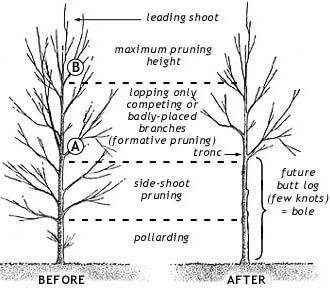
The main aim of formative pruning is to produce a tree which in maturity will be free from any major physical weaknesses and which will complement the management objectives for the site. If, in order to influence the structure, shape or size of a tree crown, formative pruning has been started in the nursery, any pruning at or soon after planting should be kept to a minimum in order to retain an adequate leaf area. Formative pruning should normally be resumed three to five years later, but if the tree has been allowed to develop an unsuitable branch structure, some of the branches may be shortened or removed at an earlier stage of establishment. The early removal of all the lowermost branches should, however, be avoided if possible, as it could impair the development of a sturdy taper in the stem. If branches need to be removed or shortened to deal with undesired patterns of growth, this should be done in stages so as not to remove too much leaf cover at any one time. Ideally, none of the selected branches to be removed should exceed 20 mm in diameter at the point of attachment to the stem. At least two-thirds of the height of the tree should always consist of live crown. Within areas of high usage or formal plantings, potentially weak unions in young trees should be managed so that only one dominant stem or branch continues to grow from such a union. Where the total removal of an unwanted co-dominant stem or branch would create a large wound, it should instead be shortened, thus causing it to lose dominance as set out in the guidelines of BS3998: 2010.

"Alexander Carson recently carried out pruning works to large trees and shrubbery in the garden of our property in Middleton St George. The work was completed on the agreed date in a professional manner to a very high standrard . Consideration was extended to leave the site in a clean and tidy condition. The polite working attitude on site was also a compliment to the company."

 - A Yell.com review

For a swift and efficient crown reduction service, call us now on